

Outsourced vs. In-House Bookkeeper: What Makes Sense for a Small Law Practice?
When you're a sole practitioner or a two- or three-lawyer firm, bookkeeping lands in an awkward spot. There isn't enough work to justify a full-time hire, but there's far too much to keep doing it yourself after hours. And because it's a law practice, the books aren't just about taxes. They have to meet the Law Society of Ontario's By-Law 9.
Here's an honest look at your three options.
Option 1: Do it yourself
Many new practices start here, and it can work while the practice is small. The LSO allows it: you choose your own accounting system and can keep the records yourself.
The catch is time and consistency. Trust reconciliations are due every month, and the LSO expects the trust comparison reviewed by the 25th of the following month. When files get busy, the books are usually the first thing to slip. By year end, your CPA may be billing you to rebuild months of records.
Option 2: Hire an in-house bookkeeper
An in-house bookkeeper makes sense once a firm has steady, daily transaction volume: several lawyers, real estate closings every week, or a large trust account.
For a small practice, the costs add up quickly: salary, payroll deductions, vacation, software, desk space and supervision. You also need someone who knows By-Law 9, which general bookkeepers often don't. And if that one person leaves, the knowledge leaves with them.
Option 3: Outsource to a bookkeeper who knows By-Law 9
For most small firms and paralegal practices, outsourcing hits the middle ground. You pay for the hours the work actually takes, and the monthly routine happens on schedule whether you're in trial or on vacation.
One thing doesn't change with outsourcing: under the LSO's rules, you can delegate the bookkeeping, but you remain responsible for it. That's why the person you hire matters more than the price.
Compare different options
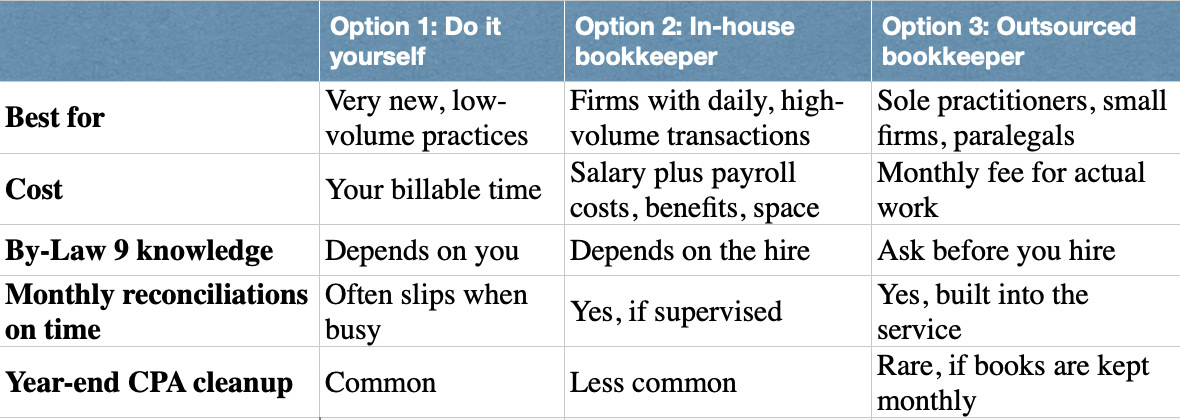
Questions to ask any bookkeeper before you hire
Have you prepared monthly three-way trust reconciliations for an Ontario law or paralegal practice?
Do you know the difference between a mixed trust account and a separate interest-bearing trust account?
Will my reconciliation package be ready for my review before the 25th each month?
What software do you work in, and who owns the data?
What happens if a client trust ledger shows an overdrawn balance?
If they can't answer these clearly, keep looking.
How FalconSight Accounting can help
FalconSight Accounting works with sole practitioners, small law firms and licensed paralegals in London, Ontario and across the province, fully remotely. We handle the monthly bookkeeping and trust reconciliations, so you can stay focused on clients and hand your CPA clean records at year end.
Not sure which option fits your practice?[Book a free 30-minute call] and we'll talk it through.
Frequently asked questions
Can a lawyer in Ontario outsource bookkeeping? Yes. The LSO allows licensees to delegate bookkeeping, but the licensee stays responsible for compliance with By-Law 9.
Do paralegals need a bookkeeper? Licensed paralegals follow the same By-Law 9 record-keeping rules as lawyers, so the same options apply.
Is an outsourced bookkeeper cheaper than hiring in-house? For most small practices, yes, because you pay only for the work done instead of a full-time salary and payroll costs.
This article is general information based on the LSO Bookkeeping Guide, not legal advice.
Written by Erika T. Hoang, B.Comm (Accounting), founder of FalconSight Accounting Inc., London, Ontario.