

Trust accounts get all the attention, and for good reason. But your general account, the everyday operating account for your practice, has Law Society of Ontario rules too. Getting it wrong usually means one of two things: money that belongs in trust ends up in general, or your own money ends up in trust.
Here's what the LSO's Bookkeeping Guide says.
What belongs in the general account
Deposit money to your general account only when it is entirely one of these:
Payment for completed legal services that you've already billed
Reimbursement for proper expenses you paid on a client's behalf
Your own or your firm's money
If a payment is a mix, split it. For example, if a client overpays a bill, your portion goes to general and the excess goes back to the client from trust.
What the general account is for
This is the account that runs your practice. You use it to:
Deposit payments for billed, completed work
Pay practice expenses such as rent, office supplies, staff salaries and bank charges
Pay disbursements for clients
Pay yourself
What stays out of trust
The flip side matters just as much. The LSO says trust accounts are to be used only for the provision of legal services, so don't deposit your own money into trust, even to cover bank fees. Your agreement for a mixed trust account should have the bank take trust account service charges from your general account instead.
Don't use a personal account
It's tempting, especially when you're starting out, to run the practice through your personal chequing account. The LSO advises against it. Personal accounts may not provide the bank statements, returned cheques and duplicate deposit slips you need, and any account you use for your practice must be produced if the LSO asks for it. A dedicated business account keeps your records clean and your personal finances private.
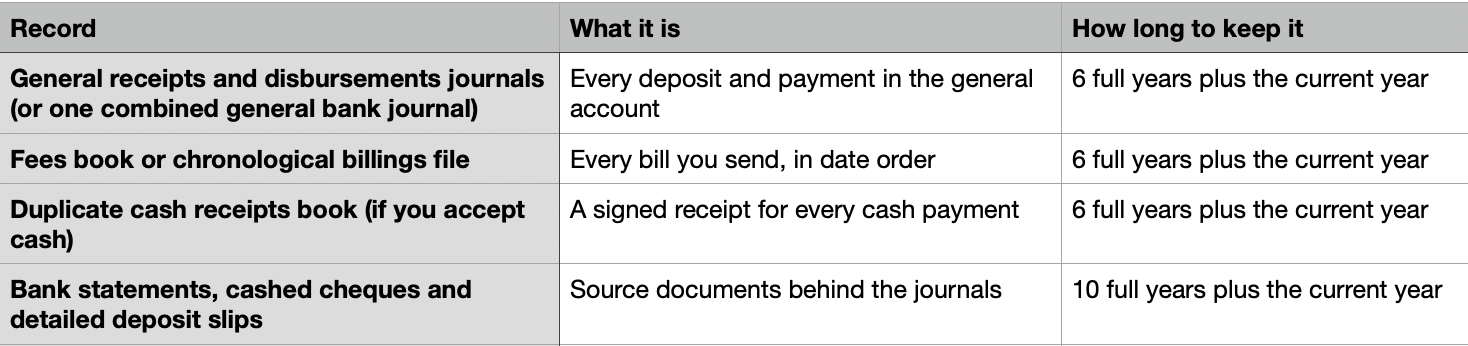
Note: Bank statements fall under the longer 10-year rule, even for your general account.
Your general account and your taxes
The LSO points out that good general account records also help you meet your income tax and HST filing obligations with the Canada Revenue Agency. Clean monthly books mean your CPA isn't rebuilding your year at tax time. For specific tax questions, check the CRA's guidance or ask your accountant.
Common general account mistakes to avoid
Depositing a retainer for future work into general instead of trust
Depositing a mixed payment in full to one account instead of splitting it
Paying personal expenses from the practice account without recording them
Letting the general account go unreconciled because "it's not trust"
Losing track of which bills have been paid
How FalconSight Accounting can help
FalconSight Accounting keeps both sides of your books current, trust and general, for sole practitioners, small law firms and licensed paralegals in London, Ontario and across the province. That means monthly general account reconciliations, an up-to-date fees book, and clean records ready for your CPA and the CRA at year end.
Want your general account books off your plate? [Book a free 30-minute call].
Frequently asked questions
What money goes into a law firm's general account? Only money that is entirely payment for billed, completed services, reimbursement of expenses you paid for a client, or your own or your firm's money.
Can I use my personal bank account for my law practice? The LSO advises against it. Personal accounts may not give you the records you need, and any account used for the practice must be produced on the LSO's request.
Can I keep my own money in the trust account to cover bank fees? No. Trust accounts are for legal services only. Arrange for trust account service charges to come out of your general account.
How long do I keep general account records? Journals, the fees book and cash receipts: 6 full years plus the current year. Bank statements and cheques: 10 full years plus the current year.
This article is general information based on the LSO Bookkeeping Guide, not legal or tax advice.
Written by Erika T. Hoang, B.Comm (Accounting), founder of FalconSight Accounting Inc., London, Ontario.